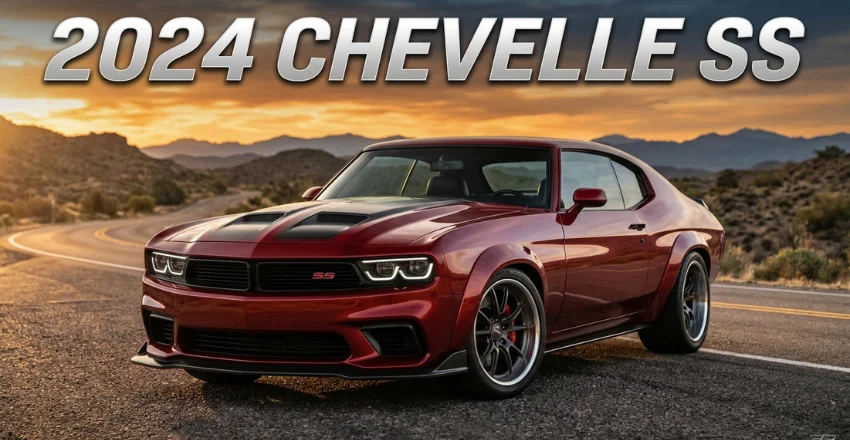

No, Chevrolet did not sell a factory 2024 Chevelle SS in the United States. General Motors announced its 2024 Camaro plans on March 22, 2023, without announcing a Chevelle successor. Chevrolet then detailed the 2024 Camaro lineup on June 5, 2023, again without introducing a new Chevelle.
That distinction matters because convincing renderings and custom cars continue circulating online. Some are labeled as new Chevrolet production models despite having no factory connection. Others show a real specialty-built car called the 70/SS, which is not a Chevrolet production Chevelle. For more car explainers, browse our automobile guides.
2024 Chevelle SS: Key Facts
| Question | Verified answer |
|---|---|
| Did Chevrolet sell one for model year 2024? | No |
| Did GM announce a factory Chevelle revival for 2024? | No such model appeared in GM’s official 2024 performance announcements |
| What is the modern 70/SS? | A specialty vehicle from Trans Am Worldwide |
| Is the 70/SS a Chevrolet dealership model? | No |
| Why do realistic images exist? | Independent renders, concept videos, and specialty builds circulate online |
| When did the original Chevelle arrive? | 1964 |
| When did the original SS era covered here end? | 1973 was the final Chevelle SS year |
Direct answer: Chevrolet never offered a factory-built 2024 Chevelle as part of its U.S. model lineup. The modern car often confused with one is Trans Am Worldwide’s 70/SS. Independent digital concepts have also helped spread the revival story.
Where the New-Chevelle Rumor Came From
A major source is the real 70/SS project from Trans Am Worldwide. SEMA reported its public release on May 12, 2022. The specialty builder created a modern tribute inspired heavily by the 1970 Super Sport.
The vehicle used modern Camaro foundations rather than becoming a new Chevrolet nameplate. Automotive coverage later shortened descriptions into phrases such as “Chevelle resurrection” and “modern Chevelle.” That wording made the distinction less obvious to casual readers.
The confusion grew during 2024 as new renderings and videos appeared online. A HotCars Renders video published February 15, 2024 openly described its car as a digital concept. Other posts presented similar imagery with much less obvious disclaimers.
Trans Am Worldwide also continued developing its real 70/SS program during this period. LSX Magazine reported new 70/SS information on January 30, 2024. Those developments gave rumor publishers real material that could be mixed with fictional factory-revival claims.
What Chevrolet Actually Said About Its 2024 Performance Cars
General Motors issued a dated announcement on March 22, 2023 about the Camaro’s future. GM said sixth-generation Camaro production would conclude after model year 2024. It also said it wasn’t announcing an immediate Camaro successor at the time.
That official release discussed Chevrolet performance vehicles, including the Corvette and other performance-oriented models. It did not announce a revived Chevelle. The absence matters because a production launch normally creates extensive manufacturer documentation.
Chevrolet followed with another official release on June 5, 2023. That announcement covered the final Camaro Collector’s Edition and the 2024 Camaro range. Chevrolet listed LT, LT1, SS, and ZL1 models, plus their available engines.
Those dated GM materials provide a better reference than speculative videos. They document what Chevrolet was announcing for model year 2024. They provide no factory specifications, MSRP, ordering information, or release schedule for a Chevelle.
How to Spot Fake Chevelle Concept Videos
Start by checking whether the claimed vehicle appears on Chevrolet or GM’s official media channels. Real production announcements usually create newsroom releases, model pages, ordering information, and dealership materials. A viral video alone does not establish that a car exists.
Next, inspect what the video claims about specifications and pricing. Fictional concepts often provide exact horsepower, acceleration, trim, and MSRP figures without linking primary documentation. Treat those numbers as invented unless Chevrolet or another identified manufacturer supports them.
Visual inconsistencies can also expose generated or unofficial imagery. Watch for changing badges, distorted lettering, impossible reflections, or body details that shift between shots. AI-created automotive images often struggle with repeated text and small mechanical details.
Also check whether footage quietly switches between different vehicles. A video may mix computer renderings with clips of a Trans Am Worldwide 70/SS. That editing can make an independent specialty build look like proof of a GM factory program.
Finally, read the source’s own wording carefully. Terms such as “render,” “what if,” “prediction,” and “concept” identify speculation. A dramatic thumbnail saying “official reveal” does not override those disclosures.
Chevelle SS History From 1964 Through 1973
1964–1965: The Malibu SS Begins the Story
The Chevelle debuted for the 1964 model year on Chevrolet’s intermediate platform. GM’s heritage material identifies the Chevelle Malibu SS among Chevrolet’s early muscle-era offerings. Chevrolet initially treated Super Sport more as a sporty package than a guaranteed big-block formula.
The performance story changed sharply during 1965. Chevrolet introduced the limited Z16 package with a 396-cubic-inch V8 rated at 375 horsepower. Factory documentation lists the engine alongside upgraded supporting equipment.
1966–1967: SS 396 Becomes a Serious Performance Series
For 1966, the SS 396 became its own series in the U.S. market. Buyers could identify these cars through specific body and VIN series information. The 396 big-block became central to the model’s performance identity.
The formula continued into 1967 with several 396 choices. Styling and equipment evolved, while the Super Sport remained firmly associated with big-block performance. These cars helped establish the image collectors still associate with the badge.
1968–1969: A New Body and Changing Package Structure
Chevrolet redesigned the Chevelle for 1968 with a shorter-wheelbase coupe and more sculpted styling. GM later highlighted the 1968 SS 396 in its official Super Sport history. This generation created the proportions that led into the famous 1970 model.
For 1969, Chevrolet shifted the SS 396 from a separate series to an equipment option. That change matters to collectors because identification became more documentation-dependent. A badge or appearance alone cannot establish every car’s original factory configuration.
1970: The Big-Block High Point
The 1970 model remains one of the best-known American muscle cars. Chevrolet offered 454-cubic-inch big-block power alongside the 396-family engines. The LS6 version was factory-rated at 450 gross horsepower.
GM’s heritage collection highlights the 454’s importance during this period. Chevrolet’s historical materials also tie the model closely to the muscle-car peak. Collectors consequently place great value on documentation surrounding genuine examples.
1971–1972: The SS Formula Changes

The market changed quickly after 1970. Insurance pressure, emissions requirements, compression changes, and revised horsepower measurements reshaped Detroit performance. Chevrolet also changed how the SS equipment package could be configured.
By 1972, published horsepower figures looked far lower than earlier gross ratings. Part of that difference came from the move toward SAE net measurements. The muscle-car market itself was changing at the same time.
1973: The Colonnade Redesign
Chevrolet redesigned its intermediate cars for 1973 around GM’s new Colonnade architecture. The body became larger and placed greater emphasis on comfort and safety. Traditional hardtop proportions also changed substantially.
An SS package remained available in 1973. This became the final original-production year for the Chevelle SS designation. The broader Chevelle name continued afterward, but its classic Super Sport chapter had closed.
Modern Alternatives for Someone Who Wanted a New Chevelle
The closest factory Chevrolet alternative from the same period is the 2024 Camaro SS. Chevrolet’s June 5, 2023 announcement confirms its 6.2-liter LT1 V8. A used example now offers genuine Chevrolet muscle without pretending to be a revived nameplate.
The Corvette Stingray provides another Chevrolet V8 choice with a different layout. Chevrolet listed the 2024 Stingray with a 6.2-liter V8 and 490 horsepower. Its mid-engine chassis makes it much more sports-car focused than a traditional intermediate muscle coupe.
Ford’s Mustang GT remains another logical alternative for classic-muscle shoppers. The 2024 generation retained a front-engine, rear-wheel-drive layout and 5.0-liter V8. Its basic formula resembles traditional American muscle more closely than the Corvette’s layout.
| Alternative | Why it may appeal | Key difference from a classic Chevelle |
|---|---|---|
| 2024 Camaro SS | Chevrolet V8, rear-wheel drive | Smaller pony-car format |
| Corvette Stingray | Chevrolet V8 performance | Mid-engine, two-seat sports car |
| Ford Mustang GT | V8, rear-wheel drive, coupe | Ford rather than Chevrolet |
| Trans Am Worldwide 70/SS | Direct 1970-inspired appearance | Specialty build, not factory Chevrolet |
Restomods and Crate-Engine Builds: Rough U.S. Costs
A real classic build offers another route for buyers who want the appearance and experience. Current asking prices show finished restomods around $100,000 to $200,000 in many cases. More elaborate pro-touring examples can be advertised around $250,000 to $350,000.
Those figures are market observations rather than fixed build prices. One current specialist listing shows a commissioned 1970 tribute package beginning around $145,900. Current finished-car listings also demonstrate how rapidly paint, chassis, drivetrain, and fabrication quality affect value.
A crate-engine project can begin much lower, but the engine is only one expense. Current retailer pricing places several Chevrolet Performance big-block crate engines around $17,000 to $35,000. Examples include the ZZ427/480, SP502/605, and ZZ632/1000.
The final car can cost far more than its engine. Builders must budget for the donor vehicle, transmission, cooling, fuel system, brakes, suspension, wiring, exhaust, bodywork, paint, and labor. Major structural repairs can also transform the budget.
Chevrolet itself continues to demonstrate classic cars with modern crate engines. On August 29, 2024, Chevrolet featured a 1969 Chevelle using its SP502/605 crate engine. That project represents a genuine Chevrolet Performance connection without creating a fictional new model.
Should You Buy a 70/SS or Build a Restomod?
The choice depends on what you value most. A 70/SS delivers a modern specialty-built interpretation with strong visual links to 1970. A classic restomod gives you an original-era body with modernized mechanical hardware.
Documentation should guide either purchase. Ask who built the car, which chassis and drivetrain parts were used, and what warranties apply. For a genuine classic, verify whether any claimed SS identity is supported by the correct paperwork.
Budget also changes the decision. Buying an existing finished restomod may reduce the uncertainty of a long custom project. Commissioning a car gives you more control, but labor and finishing choices can add substantial costs.
Frequently Asked Questions
Is the 2024 Chevelle SS a real Chevrolet?
No, Chevrolet did not offer that model through its normal U.S. production lineup. Official GM announcements for model year 2024 documented Camaro and other performance products instead. The commonly confused 70/SS comes from an independent specialty builder.
Did Chevrolet announce a price for a 2024 Chevelle?
No factory Chevrolet MSRP exists because Chevrolet did not sell such a model. Online prices attached to a supposed new factory Chevelle should not be presented as Chevrolet pricing. Specialty builds and restomods have their own independent prices.
What is the Trans Am Worldwide 70/SS?
It is a modern specialty car inspired strongly by the 1970 Super Sport. SEMA reported the program’s public release in May 2022. It should be described separately from any Chevrolet factory-production vehicle.
Why are there so many realistic new-Chevelle pictures?
Digital artists can now produce extremely convincing automotive renders. AI image tools have increased the volume and realism of fictional vehicle imagery. Always look for manufacturer documentation before treating a rendering as a production car.
What is the safest way to get a modern Chevelle-style car?
You can buy a documented specialty build or commission a restomod from an established builder. Another option is modifying a genuine classic with modern Chevrolet Performance components. Verify the vehicle’s identity, parts, workmanship, and paperwork before paying.
The Bottom Line
There was no factory Chevrolet revival for model year 2024. The rumor combines nostalgia, independent concept art, viral videos, and a real 70/SS specialty program. None of those elements create an official Chevrolet production model.
For enthusiasts, the good news is that several genuine options exist. A classic restomod can provide authentic styling with modern hardware. A Camaro, Corvette, Mustang, or specialty 70/SS can offer a modern performance experience without rewriting Chevrolet history.
Before sharing or buying anything presented as a new Chevelle, trace the claim back to its manufacturer. Check official announcements and documentation rather than trusting a thumbnail or render. That simple check separates real cars from convincing internet concepts.