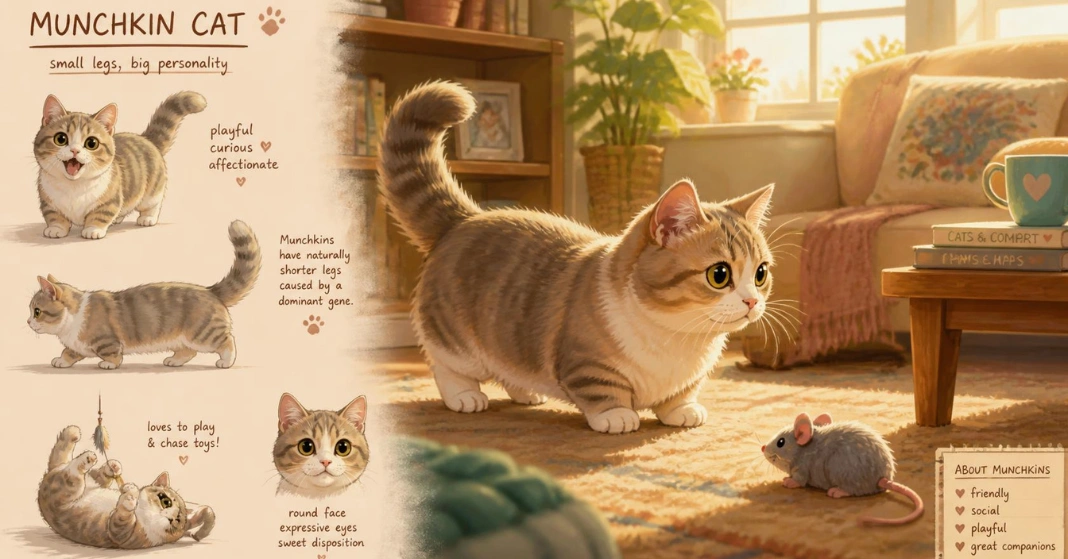

The munchkin cat is known for an average-sized body set on unusually short legs, a trait linked to inherited chondrodysplasia. These cats are often described as playful, curious, and social, yet their unusual build has also created a continuing debate about mobility and long-term joint health. Before bringing one home, U.S. owners should understand both the appealing personality and the health questions surrounding the breed.
A Munchkin is a small-to-medium cat with a normal-sized torso and unusually short legs caused by inherited chondrodysplasia. Most are playful, social, and curious, but the breed remains controversial because its defining trait may affect mobility and joint health. Prospective owners should prioritize veterinary care, healthy weight, accessible furniture, and careful sourcing.
Munchkin Breed Facts at a Glance
| Feature | What U.S. Owners Should Know |
| Adult size | TICA lists females around 5–7 pounds and males around 7–10 pounds. |
| Height | Many breed profiles place adults around 6–9 inches tall. |
| Coat | Both shorthaired and longhaired cats occur, with many colors and patterns. |
| Temperament | Commonly described as playful, curious, social, and people-oriented. |
| Lifespan | Many veterinary profiles cite about 12–15 years, while TICA lists 15–18+ years. |
| Breed recognition | TICA recognizes the breed, while PetMD notes that CFA does not. |
| Typical breeder pricing | Current online U.S. estimates commonly fall around $1,000–$2,500, although prices vary widely. |
Key Takeaways
- Short legs come from a documented genetic variant associated with disproportionate dwarfism.
- The breed can remain active and playful, but reputable sources disagree about the extent of long-term joint and mobility risk.
- Keeping the cat lean and making climbing, litter access, and resting places easy may reduce unnecessary physical strain.
- Adoption deserves consideration before purchasing, while buyers should verify breeders, health records, contracts, and payment practices.
Munchkin Cat Personality: What Living With One Is Like
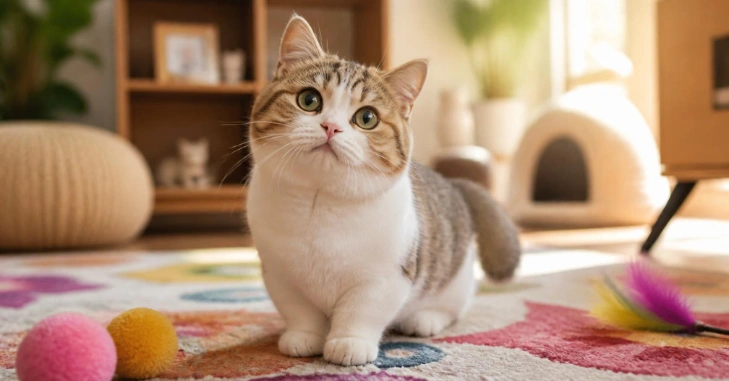
TICA describes these short-legged cats as energetic, curious, confident, and interested in company. They often enjoy chasing toys, investigating rooms, Munchkin Cat, and spending time around their people. TICA also reports that many live comfortably with children, dogs, and other household pets when introductions and socialization are handled properly.
Their shortened legs do not automatically produce a quiet or inactive personality. PetMD describes them as sociable, playful, intelligent cats that generally enjoy interaction after having an opportunity to use their energy. Individual temperament still matters, so prospective owners should judge the specific cat rather than expecting every member of the breed to behave identically.
Why Are Their Legs So Short?
The modern breed traces much of its history to a short-legged pregnant cat found in Louisiana in 1983. TICA accepted the breed into its New Breed development program in 1994 and later granted Championship status in 2003. Reports of short-legged domestic cats predate that program, so the physical trait itself did not originate with modern breeders.
A 2020 peer-reviewed genetics study found a structural variant within the UGDH gene that was perfectly associated with the standard short-legged phenotype in its sample. Researchers proposed dominant inheritance for the visible trait and suggested that inheriting two mutant copies may be embryonically lethal. That study clarified the genetic mechanism, but it did not settle every question about long-term mobility, arthritis, or quality of life.
Health and Welfare Questions Owners Should Understand
Health guidance differs depending on the source, which is why sweeping claims in either direction deserve caution. TICA states that the short legs do not prevent normal mobility or survival, while its current breed profile lists a life expectancy of 15–18 years or more. PetMD takes a more cautious position and notes that altered cartilage development may predispose affected cats to osteoarthritis and mobility problems.
Animal-welfare organizations express stronger concerns about breeding for dwarfism. UFAW warns that shortened limbs can restrict normal movement and may increase abnormal joint loading, while Cats Protection advises prospective owners to consider cats without extreme physical traits. These positions do not mean every individual will suffer identical problems, but they give owners good reason to monitor comfort, movement, weight, and behavior throughout life.
Watch for changes such as stiffness after resting, reduced willingness to jump, hesitation on stairs, changes in grooming, or withdrawal from normal play. Cats often mask pain, so gradual behavioral changes can matter even when there is no obvious injury. A veterinarian can assess body condition, joints, gait, and other causes before discomfort becomes harder to manage.
Daily Care and a More Accessible Home
Most basic care resembles care for other domestic cats, including complete nutrition, fresh water, litter hygiene, dental attention, enrichment, and preventive veterinary visits. The difference is that owners may find it helpful to arrange important resources where the cat can reach them without repeated high jumps. Low-entry litter boxes, sturdy intermediate steps, low platforms, and stable climbing furniture can make daily movement easier.
Useful home adjustments include:
- Choose a litter box with a comfortably accessible entrance.
- Place beds and favorite resting areas at reachable heights.
- Offer scratching surfaces that work from floor level.
- Use stable steps or ramps for a cat that struggles with higher furniture.
- Keep slippery floors covered in frequently used activity areas.
- Encourage interactive floor-level play without forcing strenuous jumps.
Weight control also deserves attention because excess body weight places more load on joints in any cat. Ask your veterinarian to show you how to assess body condition instead of relying only on the number shown by a scale. Diet changes, joint products, supplements, or pain medication should be discussed with a veterinarian rather than added automatically.
Grooming needs depend largely on coat length. TICA recommends combing shorthaired individuals about once a week and longhaired individuals about twice a week to remove loose hair and limit tangles. Owners should increase grooming help if limited mobility makes normal self-grooming difficult.
For more animal-care topics on the site, readers can browse Blogzely’s pet care and animal health section. That section currently contains additional pet-safety coverage and provides a natural hub for future cat content. Building more feline articles around this page would also strengthen Blogzely’s topical depth.
Size, Growth, and Lifespan
Despite the name, these cats do not remain kitten-sized throughout adulthood. TICA classifies the breed as medium-sized and lists adult females around 5–7 pounds and males around 7–10 pounds, although genetics can create variation. Their legs remain short while the torso develops to a normal adult proportion.
Published lifespan estimates are less consistent. Several veterinarian-reviewed profiles give a typical range near 12–15 years, while TICA currently lists 15–18 years or more. Rather than treating either figure as a guarantee, owners should focus on preventive care, healthy body condition, dental health, safe indoor living, and early investigation of changes in movement or behavior.
U.S. Cost, Adoption, and Choosing a Breeder
Current online U.S. breed guides and directories commonly place kitten prices around $1,000 to $2,500, although lineage, location, breeder practices, and demand can change the asking price. A higher price does not prove responsible breeding, strong health screening, or good living conditions. Owners should also budget for routine veterinary care, food, supplies, preventive treatment, and possible future mobility-related expenses.
The ASPCA recommends considering shelter or rescue adoption before purchasing a purpose-bred animal. Purebred short-legged cats are less common in shelters, so finding one may require patience and a wider search area. Choosing a healthy cat that fits your household matters more than pursuing a particular appearance.
If you decide to work with a breeder, TICA recommends careful verification before money changes hands:
- Verify the cattery or breeder through an established registry.
- Ask for veterinary, genetic, vaccination, and parent health records.
- Meet the cats in person when possible, or request a live video visit.
- Read a written contract and understand the health guarantee.
- Avoid pressure to pay quickly, especially by wire transfer or gift card.
- Confirm what support or return policy applies after the kitten comes home.
TICA specifically warns buyers about sellers who hide their physical identity, create urgency, refuse direct communication, or demand unusual payment methods. A responsible seller should be comfortable answering detailed questions about health, pedigree, socialization, and living conditions. These checks matter far more than a polished website or a low advertised price.
Blogzely also covers the broader principle of veterinary guidance in its guide to whether Pepto-Bismol is safe for dogs. The species is different, but the safety lesson applies here too: do not give human medicines or unapproved treatments to a cat without professional advice. Readers can find broader home and family coverage in Blogzely’s lifestyle articles.
Conclusion
The Munchkin Cat is one of the most distinctive cat breeds, recognized for its unusually short legs, playful personality, and often social nature. While these cats can be affectionate, curious, and active companions, their unique body structure also makes responsible ownership and informed decision-making especially important. The short-legged trait is linked to a genetic variant affecting limb development, and veterinary and animal-welfare sources continue to discuss its potential relationship with mobility and joint health.
Frequently Asked Questions
Why do Munchkins have short legs?
Their short legs are associated with a structural genetic variant affecting normal long-bone development. Researchers linked a UGDH variant to the standard short-legged phenotype in a 2020 study. The result is disproportionate dwarfism, meaning the limbs are shortened while the torso remains closer to ordinary feline proportions.
How big do Munchkins get?
Adults generally fall within the small-to-medium range rather than staying kitten-sized. TICA currently lists females around 5–7 pounds and males around 7–10 pounds. Other breed profiles commonly report heights near 6–9 inches, with natural variation between individuals.
How long do Munchkins live?
Many veterinarian-reviewed sources cite about 12–15 years as a useful planning range. TICA publishes a longer estimate of 15–18 years or more, which shows that published figures are not uniform. Genetics, body condition, preventive care, environment, and individual health can influence how long any cat lives.
Are Munchkins healthy?
Some individuals live active lives, but the health question should not be reduced to a simple yes or no. Veterinary and welfare sources raise concerns about osteoarthritis, mobility, and the consequences of breeding for shortened limbs, while TICA presents a more favorable assessment. Regular veterinary checks and close attention to movement provide a safer approach than assuming problems will or will not occur.
Is a munchkin cat a good pet?
It can be an affectionate and engaging companion for an owner prepared for its care needs and possible health concerns. Personality is often described as playful and social, but welfare questions surrounding the short-legged trait deserve serious consideration before acquisition. Adoption, responsible sourcing, veterinary planning, and an accessible home should all be part of the decision.
Is This Breed Right for Your Home?
Choose based on health, temperament, lifestyle fit, and your ability to provide lifelong care rather than on short legs alone. If you already live with one of these cats, focus on healthy weight, comfortable movement, enrichment, grooming, and regular veterinary examinations. If you are still deciding, compare rescue options and breeder practices carefully before making a commitment.