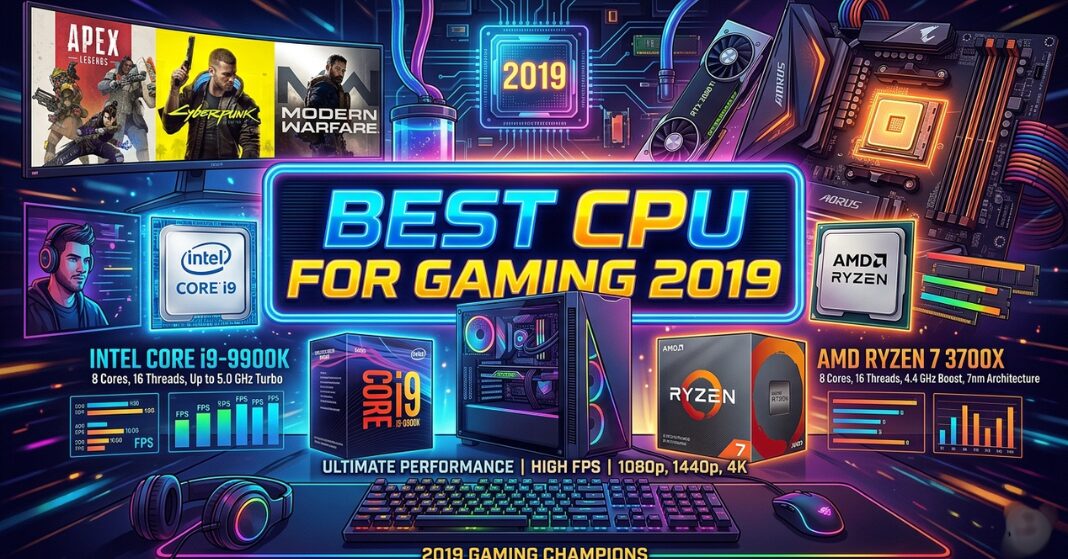

Choosing the Best CPU For Gaming 2019 was a critical decision for gamers looking to balance performance, price, and future-proofing. The year marked a major shift in the processor market, with intense competition between Intel and AMD driving innovation in core counts, thread performance, and overall efficiency. For gamers, understanding how CPUs affect frame rates, system responsiveness, and multitasking has become more important than ever.
This detailed guide explores the technical foundations behind gaming processors, including architecture, threads, cache, and real-world gaming performance, helping you understand what truly defines the Best CPU For Gaming 2019.
| Feature | Key Point | Gaming Impact | Ideal Choice |
| Architecture | Intel vs AMD designs | Affects speed & efficiency | Newer architecture |
| Cores/Threads | Processing units | Better multitasking | 6–8 cores recommended |
| Clock Speed | Measured in GHz | Higher FPS & responsiveness | Higher is better |
| Cache | Fast internal memory | Reduces lag & improves speed | Larger cache preferred |
| Performance | Real-world FPS | Smooth gameplay | Balanced CPU + GPU |
| TDP | Power consumption | Affects heat & stability | Lower is efficient |
| Overclocking | Boosting CPU speed | Extra performance | For advanced users |
| Compatibility | Works with motherboard & RAM | Ensures stability | Check before buying |
| Value | Price vs performance | Better investment | Budget-based choice |
Understanding CPU Architecture and Its Impact on Gaming

CPU architecture refers to the internal design and structure of a processor. It determines how efficiently a CPU processes instructions and communicates with other system components.
In 2019, two major architectures dominated:
- Intel’s Coffee Lake Refresh
- AMD’s Zen+ and Zen 2
Key Architectural Improvements
- Increased Instructions Per Clock (IPC)
- Better power efficiency
- Improved thermal performance
- Enhanced memory support
These improvements played a vital role in shaping the Best CPU For Gaming 2019, as better architecture directly translated into smoother gameplay and reduced bottlenecks.
Core Count vs Thread Count: What Matters More?
One of the biggest debates in 2019 gaming was whether more cores or higher clock speeds mattered more, as both played a crucial role in overall system performance.
Core Concepts Explained
Cores are the physical processing units within a CPU that handle tasks directly, while threads act as virtual cores that enable better multitasking by allowing multiple processes to run simultaneously. Together, they determine how efficiently a processor can manage workloads.
Gaming Perspective
From a gaming standpoint, most titles in 2019 relied heavily on 4 to 6 cores for optimal performance. In many cases, higher clock speeds delivered better results than simply increasing the number of cores, especially in games that were not fully optimized for multi-core usage. However, multithreaded performance proved beneficial for gamers who streamed, recorded gameplay, or ran background applications alongside their games.
Practical Insight
In practical terms, a 4-core processor was generally suitable for entry-level gaming, providing acceptable performance for less demanding titles. A 6-core CPU became the sweet spot for most gamers, offering a balance between performance and cost. Meanwhile, processors with 8 or more cores were ideal for users who needed additional power for streaming, multitasking, or handling more demanding workloads beyond gaming.
The Role of Cache Memory in Gaming Performance
Cache memory is a small, high-speed storage area within the CPU that stores frequently used data.
Types of Cache
- L1 Cache: Fastest but smallest
- L2 Cache: Moderate speed and size
- L3 Cache: Larger but slightly slower
Why Cache Matters
- Reduces latency
- Improves data access speed
- Enhances overall system responsiveness
Clock Speed and Its Influence on FPS
Clock speed, measured in GHz, determines how many cycles a CPU can execute per second and plays a critical role in overall gaming performance. Higher clock speeds generally result in better single-thread performance, which is especially important for games that rely on fewer cores. Additionally, modern processors use boost clocks to provide temporary performance spikes when extra power is needed.
From a gaming perspective, faster CPUs can deliver higher frame rates, reduce stuttering in CPU-intensive titles, and improve overall responsiveness, particularly in competitive scenarios. For many gamers, high clock speeds were a defining feature of the Best CPU For Gaming 2019, especially in esports titles where every millisecond of performance mattered.
Best CPU For Gaming 2019: Gaming Performance
While specifications are important, real-world performance tells the full story.
Performance Factors
- Game engine optimization
- GPU pairing
- RAM speed and configuration
- Background applications
Typical Gaming Results
- Intel CPUs often led in raw FPS
- AMD CPUs offered better multitasking and value
- Differences were minimal at higher resolutions (1440p, 4K)
Intel vs AMD: The 2019 Showdown
The competition between Intel and AMD reached new heights in 2019, creating one of the most dynamic periods in CPU development and giving gamers more choices than ever before.
Intel Advantages
Intel processors stood out for their higher clock speeds, which translated into excellent single-core performance. This advantage enabled them to deliver strong gaming benchmarks, particularly in titles that relied heavily on fast, single-core performance.
AMD Advantages
On the other hand, AMD gained significant attention by offering more cores and threads at competitive prices, making their processors highly appealing for multitasking and content creation. They also featured larger cache sizes, which improved efficiency and responsiveness across many gaming scenarios.
Market Impact
AMD’s Ryzen 3000 series significantly disrupted the market, pushing Intel to adjust its pricing strategy and enhance its product lineup. This intense rivalry ultimately benefited gamers, as it led to better performance, more features, and improved value across the board for those searching for the Best CPU For Gaming 2019.
Key Features to Consider When Choosing a Gaming CPU
Selecting the right processor involves more than just looking at benchmarks.
- Core and thread count
- Clock speed (base and boost)
- Cache size
- Power consumption (TDP)
- Compatibility with the motherboard
- Future upgrade path
- Cooling requirements
- Overclocking support
Comparison Table of Popular Gaming CPUs in 2019
Top Gaming CPU Comparison (2019)
| CPU Model | Cores/Threads | Base Clock | Boost Clock | Cache (L3) | Gaming Performance Level |
| Intel i5-9600K | 6 / 6 | 3.7 GHz | 4.6 GHz | 9 MB | High |
| Intel i7-9700K | 8 / 8 | 3.6 GHz | 4.9 GHz | 12 MB | Very High |
| Intel i9-9900K | 8 / 16 | 3.6 GHz | 5.0 GHz | 16 MB | Extreme |
| Ryzen 5 3600 | 6 / 12 | 3.6 GHz | 4.2 GHz | 32 MB | High |
| Ryzen 7 3700X | 8 / 16 | 3.6 GHz | 4.4 GHz | 32 MB | Very High |
| Ryzen 9 3900X | 12 / 24 | 3.8 GHz | 4.6 GHz | 64 MB | Extreme |
Overclocking and Performance Tuning
Overclocking allows users to push their CPUs beyond factory settings.
Benefits
- Increased frame rates
- Better performance in demanding games
- Enhanced multitasking
Risks
- Higher temperatures
- Increased power consumption
- Potential system instability
Many enthusiasts considered overclocking when choosing the Best CPU For Gaming 2019.
How CPU Affects Different Game Genres

Different types of games utilize CPUs in different ways, making it important to understand how processing power impacts various genres. CPU-intensive games, such as strategy titles with large simulations, open-world games, and multiplayer online experiences, rely heavily on the processor to manage complex calculations.
AI behavior and large environments. On the other hand, GPU-dependent genres like first-person shooters, racing games, and AAA cinematic titles place more emphasis on graphical performance, where the graphics card handles most of the workload.
Understanding this balance allowed gamers to make smarter decisions when selecting the Best CPU For Gaming 2019, ensuring their system matched the performance demands of their preferred gaming styles.
Future-Proofing Your Gaming Setup
Even in 2019, future-proofing was an important consideration.
Key Strategies
- Choose CPUs with more threads
- Invest in newer architectures
- Ensure motherboard compatibility for upgrades
Processors with higher core counts remained relevant longer, making them strong contenders for the Best CPU For Gaming 2019.
Conclusion
The search for the Best CPU For Gaming 2019 ultimately came down to balancing architecture, threads, cache, and real-world performance. While Intel maintained an edge in raw gaming FPS, AMD revolutionized the market with better value and multi-core performance.
Understanding how these factors interact allows gamers to make informed decisions, ensuring smooth gameplay, high frame rates, and long-term system reliability. Whether you prioritized competitive gaming or multitasking, 2019 offered some of the most well-rounded CPUs in modern computing history.
Want to know about Best 1440p OLED Monitor: Complete Buying Guide, Expert Reviews, Performance Tests, and Top Picks for Gaming, Work, and Everyday Use Check out our Tech category.
FAQs
Cache played a significant role in reducing latency and improving responsiveness.
AMD offered better value and multitasking, while Intel excelled in raw gaming FPS.
Not always. Most games benefited more from higher clock speeds than extra cores.
High-end processors like the Intel i9-9900K and Ryzen 9 3900X were considered top-tier.